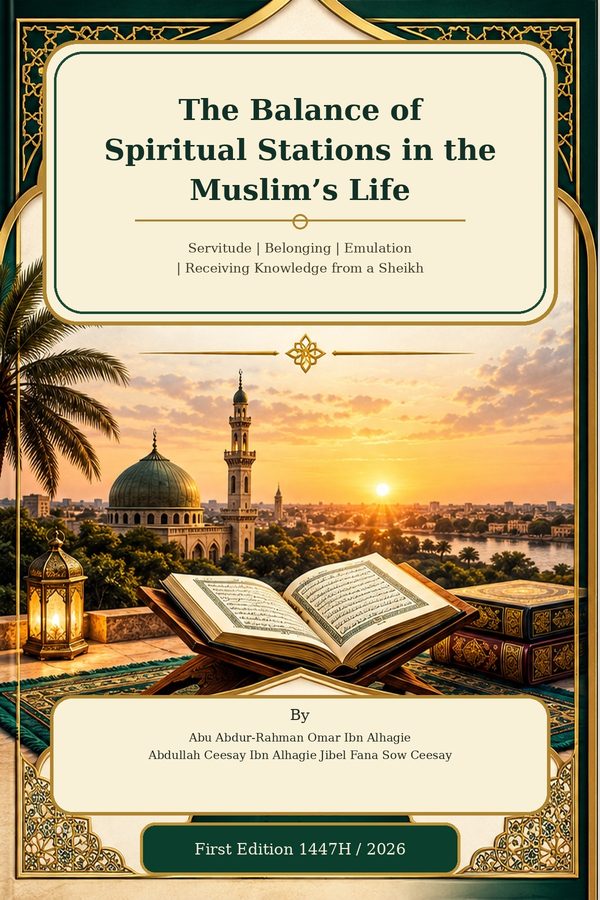

The Balance of Spiritual Stations in the Muslim’s Lifeميزان المقامات في حياة المسلم
Servitude, belonging, emulation, and receiving knowledge from a sheikhالعبودية – الانتماء – الاقتداء – التلقي عن الشيخ
ميزان المقامات في حياة المسلم
Abu Abdur-Rahman Omar Ibn Alhagie Abdullah Ceesay Ibn Alhagie Jibel Fana Sow Ceesayأبي عبد الرحمن عمر بن الحاج عبد الله سيس بن الحاج جبل فانه صو سيس
Four parts, one for each station: the Muslim as a servant of Allah, Mighty and Sublime; as one who belongs to Islam, as identity and as method; as one who emulates the Messenger ﷺ; and as a seeker of knowledge raised by an educator, the sheikh as a model. With a summary, a conclusion, and the list of references. English translation by Sidy Ahmad Gassama.يعالج جانبًا عمليًا مهمًا في حياة المسلم، وهو بيان المقامات الأساسية التي يقوم عليها بناؤه الإيماني والسلوكي: العبودية، والانتماء، والاقتداء، والتلقي عن الشيخ أو المربي. ترجمة إنجليزية بقلم Sidy Ahmad Gassama.
Contentsالمحتويات
32 sections · 305 passagesالأقسام: 32 · الفقرات: 305
- Introduction to the Bookpage صفحة 138
- Prologue: The Human Being Between Reception and Obligationpage صفحة 141
- Part 1: The Muslim Is a Servant of Allah, Mighty and Sublimepage صفحة 142
- Chapter 1: The Meaning of Servitude in the Islamic Conceptionpage صفحة 142
- Chapter 2: Why Is Servitude the Root of Every Station?page صفحة 145
- Chapter 3: Servitude and True Freedompage صفحة 149
- Chapter 4: Servitude in States of Ease and Hardshippage صفحة 152
- Chapter 5: The Relationship Between Servitude and the Stations of Faithpage صفحة 154
- Chapter 6: The Gravest Deviations from the Concept of Servitudepage صفحة 156
- Chapter 7: How Does the Muslim Train Themselves to Realize Servitude?page صفحة 159
- Chapter 8: The Fruit of This Part in the Muslim’s Lifepage صفحة 162
- Part 2: The Muslim Belongs to Islam, as Identity and as Methodpage صفحة 165
- Chapter 1: Islam Is Creed, Law, and Characterpage صفحة 166
- Chapter 2: The Comprehensiveness of Islam for the Individual and Societypage صفحة 168
- Chapter 3: The Difference Between True Belonging and Hereditary Belongingpage صفحة 170
- Chapter 4: Manifestations of Behavioural Belongingpage صفحة 172
- Chapter 5: Belonging Between Fixity and Renewalpage صفحة 174
- Summary of Part 2: The Muslim Belongs to Islam, as Identity and as Methodpage صفحة 180
- Part 3: The Muslim Emulates the Messenger ﷺpage صفحة 182
- Chapter 1: The Meaning and Reality of Emulationpage صفحة 183
- Chapter 2: The Comprehensiveness of Prophetic Emulationpage صفحة 188
- Chapter 3: The Danger of Separating the Sunnah from Realitypage صفحة 193
- Summary of Part 3page صفحة 198
- Part 4: The Muslim as a Seeker of Knowledge and One Who Is Raised by an Educator, the Sheikh as a Modelpage صفحة 200
- Chapter 1: Knowledge and Purification Without Deificationpage صفحة 201
- Chapter 2: The Standing of the Sheikh and the Scholar in Islampage صفحة 203
- Chapter 3: Governing Principles for the Relationship with the Religious Sheikhpage صفحة 208
- Summary of Part 4page صفحة 217
- Complete Summary of the Bookpage صفحة 219
- Comprehensive Summarypage صفحة 221
- Conclusion of the Bookpage صفحة 222
- References and Sourcespage صفحة 223